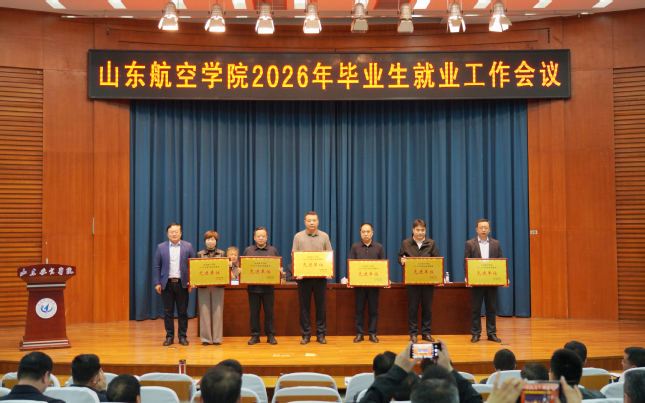
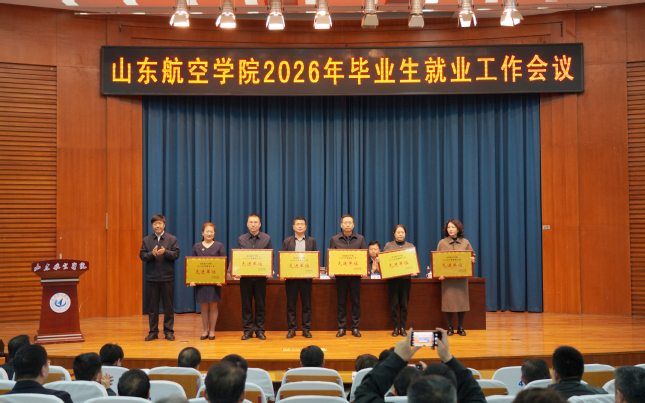
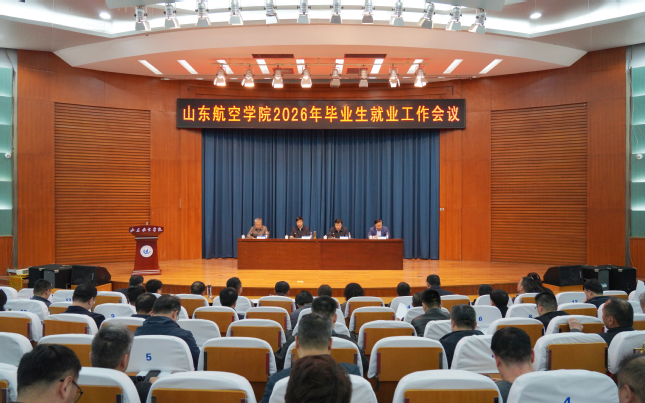
On March 27, Shandong University of Aeronautics (SDUA) held the 2026 Graduate Employment Work Conference in Mingde Lecture Hall. Li Weinian, Deputy Secretary of the Party Committee and President of the university, attended the conference and delivered a speech. Also in attendance were Gong Xinjun, Liu Baomin, and Du Wei, members of the Party Committee and Vice Presidents of the university, as well as Lin Xiaojin, a member of the Party Committee and Head of the United Front Work Department.
Li Weinian affirmed the achievements of the university’s employment work for the 2025 graduates, analyzed the existing problems, and assessed the new situation facing the 2026 graduates’ employment work. He pointed out that the number of national college graduates has reached a new record high this year, while SDUA’s own graduate population will hit a peak in recent years, accompanied by the first cohort of master’s degree graduates. This presents a dual challenge of a surge in total employment demand and new graduate groups to serve. Meanwhile, the accelerated development of the aerospace industry and the boom in the low‑altitude economy are converging with the university’s distinguishing feature in aerospace education, creating a historic opportunity for employment work. Regarding the 2026 employment work, he put forward four requirements: First, the integration efforts should be deepened. Enrollment, talent cultivation, and employment processes should be linked; the integration of science, industry, and education should be enhanced; career planning education should be embedded throughout the entire process of talent development; and employment support should be consolidated through high-quality talent cultivation. Second, genuine effort should be put into practicality. The quality and efficiency of enterprise visits and job expansion should be improved; cooperation with leading enterprises in the aerospace sector should be deepened; the employment foundation for aerospace majors should be strengthened; and full use should be made of policy-supported positions. Third, the brand of excellence should be upheld. Employment perceptions should be guided; key aspects such as postgraduate admission adjustments and doctoral application guidance should be focused on; a “one-file-per-student” assistance mechanism for disadvantaged graduates should be established; and the bottom lines of employment data authenticity and security should be strictly adhered to. Fourth, responsibility should be taken. The “top leader” accountability system for employment work should be further advanced; the four-level joint responsibility mechanism should be reinforced; and employment outcomes should be incorporated into performance evaluation.
Gong Xinjun emphasized three points for implementing the spirit of the conference: First, raise political awareness and build a broad consensus. It is essential to fully recognize the critical importance of doing well in the employment work for the Class of 2026, and effectively unify thoughts and actions with the decisions and arrangements of the university’s Party Committee and administration. Second, strengthen accountability, and ensure thorough implementation of work. In line with The 2026 Graduates Employment Work Plan, tasks should be broken down item by item, and responsibilities should be delegated level by level. Each college must conduct a thorough self‑examination based on the issues raised at the conference and make corrective actions without delay.Third, pool efforts and uphold bottom‑line and red‑line principles. All functional departments should provide proactive services, and all secondary schools must bear their primary responsibilities, forming a work pattern of “full participation, whole-process integration, and all-around promotion,”to ensure the achievement of this year’s employment goals.
At the conference, Li Weinian presented awards to advanced units in employment work. Liu Baomin read out The Decision on Commending Advanced Units and Individuals for the 2025 Employment Work, and Du Wei presented awards to outstanding units for high-quality employment. A total of six advanced units in employment work, six advanced units in high-quality employment, and 13 advanced individuals were commended on site. The Enrollment and Employment Office delivered the employment work report for the 2025 graduates and outlined work plans for 2026. Leaders from the School of Information Engineering and the School of Aerospace Engineering and Mechanics shared experiences in employment work.
The heads of the Student Affairs Office, Academic Affairs Office, Research Office, Communist Youth League Committee, and Innovation and Entrepreneurship Institute, as well as Party secretaries, deans, and deputy Party secretaries from all secondary schools (departments), the director of the Employment Guidance Section, all counselors, and all staff members of the Enrollment and Employment Office attended the conference.